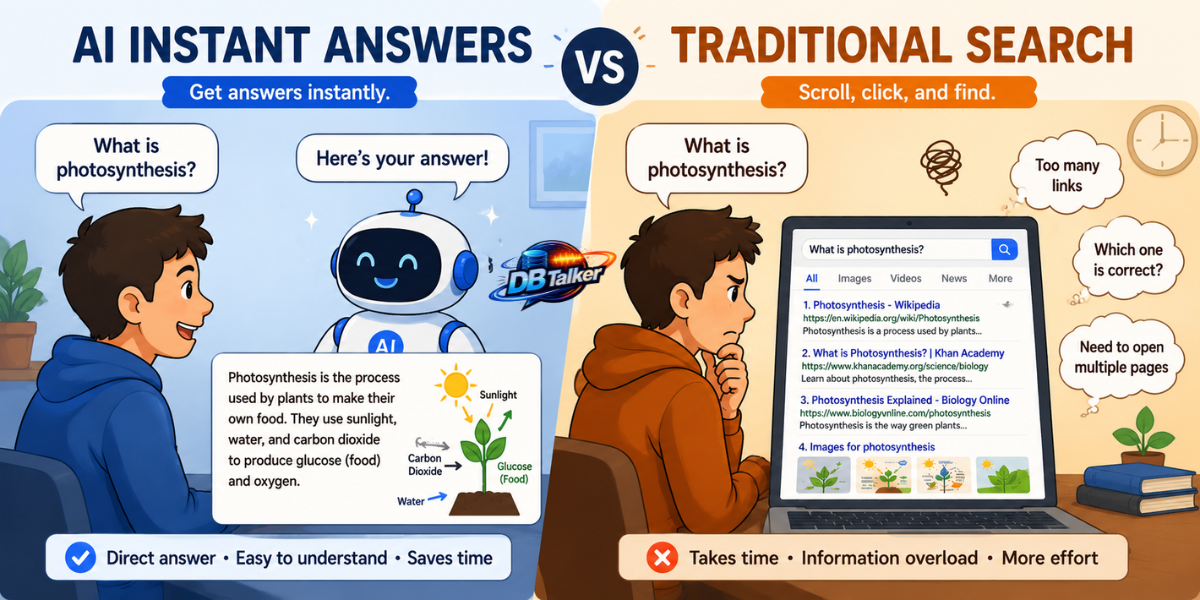
Think about the last time you typed a question into Google. You probably gotten blue links, a few ads, some featured snippets, and maybe a video or two. You then had to click, skim, go back, click again all to find one simple answer. Now compare that to asking an AI like ChatGPT, Gemini, or an AI chatbot on a website. You type your question in plain English. You get a direct, conversational answer in seconds. No clicking. No scrolling. No guessing.
That's the shift happening right now. And it's not just a tech trend it’s changing how businesses support customers, how people discover products, and how information reaches people. So, the big question is:
Are AI instant answers actually better than traditional search?
Let's break it down — honestly, clearly, and with real-world examples.
What Is Traditional Search and Why It's Still Powerful?
Traditional search engines like Google, Bing, and Yahoo work by crawling billions of web pages, indexing them, and ranking them based on hundreds of factors relevance, authority, freshness, and more.
When you search "best laptop under 50000," Google shows you a mix of:
- Ranked blog articles
- Shopping results
- News snippets
- Related questions
This model is incredibly powerful for discovery. You get diverse perspectives, multiple sources, and you can judge credibility by looking at where the result comes from.
Traditional search is still unbeatable for:
- Researching products across multiple sources
- Finding news and current events
- Deep research where you want multiple viewpoints
- Local business discovery
But here's the honest limitation traditional search gives you a map to the answer, not the answer itself. You still have to do the work.
What Is AI Instant Answers and Why Everyone Is Talking About Them?
AI instant answers (also called AI Overviews, Generative Search Results, or LLM-powered answers) use large language models to read, understand, and summarize information then deliver a direct, human-like response to your question.
You're seeing this already:
- Google's AI Overviews appear at the top of search results
- ChatGPT Search answers questions directly with citations
- Perplexity AI combines search with AI-generated summaries
- AI chatbots on websites (like those powered by DBTalker) answer customer questions instantly without any search at all
The key difference? Instead of showing you ten pages that might have your answer, AI gives you the answer directly conversationally, quickly, and in context.
AI vs. Traditional Search: A Real Comparison
|
Feature |
Traditional Search |
AI Instant Answers |
|
Speed |
Fast to results, slow to answers |
Instant final answer |
|
Format |
Links and snippets |
Conversational response |
|
Discovery |
Excellent |
Limited |
|
Accuracy |
Depends on sources |
Depends on training data |
|
Personalization |
Limited |
High (context-aware) |
|
Source transparency |
High |
Varies |
|
Best for |
Research, exploration |
Direct Q&A, support |
The truth? They're not really competitors. They serve different needs. But for specific, intent-driven questions the kind customers ask businesses every single day AI wins by a mile.
Why AI Is Winning the "Quick Answer" Game?
Here's what's happening in the real world right now:
- People Are Impatient (And That's Okay): Studies show users abandon a page if it doesn't load within 3 seconds. The same logic applies to information. If someone has to click through five articles to find your return policy, they leave or worse, they call your support line. AI answers eliminate that friction entirely.
- Conversational Queries Are Skyrocketing: With the rise of voice search and mobile usage, people are searching the way they talk. "What's the refund policy for this product?" is a conversational query. Traditional search doesn't handle that as gracefully as AI does.
- LLM Search Mode Is the New Normal: Tools like Perplexity, Google's AI Mode, Bing Copilot, and even ChatGPT are now mainstream. The shift to LLM-based search means that content needs to be not just SEO-optimized but also AI-readable, structured, and authoritative so that AI systems can cite and surface it accurately.
- Zero-Click Searches Are Exploding: A growing percentage of searches now end without a click. Users get what they need right on the results page. For businesses, this means one thing: your AI presence on your own platform matters more than ever.
Why Your Website Needs Chatbot AI Instant Answers Too?
Here's where this gets really practical for your business.
If someone lands on your website with a question "Do you offer monthly billing?" or "What file formats do you support?" what happens? They scroll. They look for a FAQ. Maybe they find it, maybe they don't. Often, they leave.
Now imagine an AI chatbot trained on your own website data is right there. It answers that question instantly, accurately, and in your brand's tone. That's exactly what DBTalker does and turns your website, documents, PDFs, and data into a smart AI support agent like having ChatGPT, but trained entirely on your content. It answers customer questions 24/7, handles repetitive queries automatically, and never gives a wrong answer about your policies because it only knows what you've taught it. It's not just a chatbot. It's an AI-powered answer engine built for your business.
What Makes AI Answers Rank in the New LLM Search Era?
If you want your content to surface in AI Overviews, ChatGPT Search, Perplexity, or Google's AI Mode, here's what actually works:
- Structured, factual content that answers specific questions clearly
- FAQ sections with natural language questions (exactly like this article)
- Clear entity relationships — who you are, what you do, who you serve
- Conversational tone that mirrors how people actually ask questions
- High E-E-A-T (Experience, Expertise, Authoritativeness, Trust)
- Fast, mobile-friendly pages that AI crawlers can parse easily
Writing for AI search isn't about stuffing keywords. It's about being the clearest, most helpful answer to a real question. That's a shift every content creator and business owner needs to embrace right now.
Final Thought:
The way people find answers is evolving faster than most businesses realize. Traditional search isn't dead but it's no longer the only game in town. AI instant answers are here, they're getting better every month, and customers are starting to expect them everywhere including on your website.
If you want to give your visitors the instant, accurate, human-like answers they expect without hiring a 24/7 support team — try DBTalker for free. Build your AI chatbot in minutes, train it on your own content, and start delivering instant answers that actually convert.