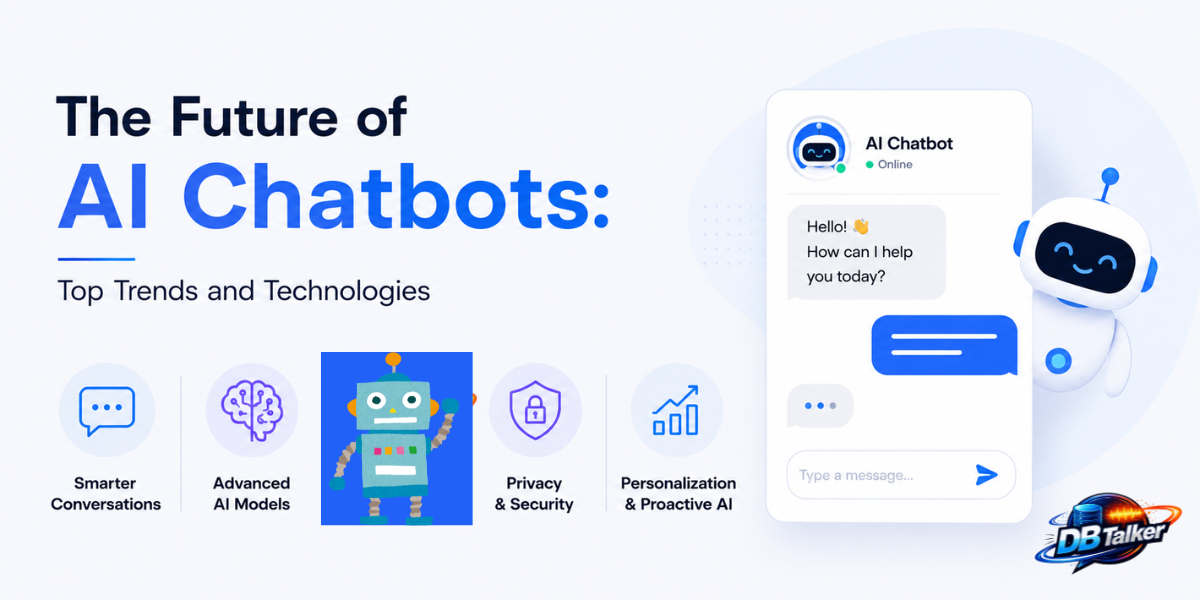
Remember those clunky pop-ups from a few years ago? You'd type a question and get a scripted, robotic reply that barely helped. Those days are long gone.
Today's AI chatbots don't just answer questions they understand context, process documents, reason through complex problems, and even take actions on your behalf. The shift has been so dramatic that 58% of consumers have already replaced traditional search engines with generative AI tools.
We're not just talking about a technology upgrade. We're talking about a complete rethink of how humans interact with information.
- Agentic AI: Chatbots That Actually Do Things
The biggest shift happening in AI right now? Chatbots are moving from answering questions to completing tasks. This is what's called Agentic AI systems that don't wait for your next prompt. They plan, reason, and execute multi-step workflows on their own. Think of it like going from a calculator to a personal assistant who can book your calendar, pull a report, send a follow-up email, and flag risks all from one instruction.
Gartner projects that by 2028, 80% of customer-facing processes will be handled by multi-agent AI systems. Right now, in 2026, Deloitte reports that 25% of companies using generative AI are already running agentic pilots and that number is set to double to 50% by 2027.
For everyday users, this means AI tools that don't just summarize your documents but can actually act on them, cross-reference data, and surface decision-ready insights.
- Multimodal AI: Text, Images, Audio — All at Once
Early chatbots were text-only. That's changing fast. Multimodal AI means today's large language models can process text, images, audio, and even video simultaneously. You can upload a PDF, a chart image, or a recorded meeting — and the AI understands all of it together.
IDC forecasts that by 2026, 40% of AI models will blend different data modalities, moving well beyond single-format limitations. This opens up massive possibilities:
- Upload a contract image and ask "What are the renewal terms?"
- Share a spreadsheet screenshot and get instant analysis
- Drop in a note and have the AI summarize key action points
This is exactly the kind of capability that powers platforms like DBTalker, where you can have a natural conversation directly with your documents no complex queries, no manual digging.
- AI Chat with Documents: The Productivity Game Changer
One of the hottest practical applications of AI chatbot technology in 2026 is AI-powered document interaction. Instead of reading through 50-page reports, legal contracts, or research papers, you simply upload the document and chat with it. Ask questions, request summaries, pull specific clauses, or compare sections all in plain conversational language.
Why does this matter?
- Knowledge workers spend an average of 2.5 hours per day searching for information
- Legal, finance, and HR teams deal with massive document volumes daily
- Traditional keyword search context AI chat understands meaning
- Hyper-Personalization Through LLMs
Generic responses are out. Personalized, context-aware conversations are in.
Modern AI chatbots now use Large Language Models (LLMs) combined with Reinforcement Learning from Human Feedback (RLHF) to understand not just what you're asking but why you're asking it, based on your history, preferences, and patterns.
This means:
- The AI remembers your previous queries and builds on them
- Responses adapt to your communication style and expertise level
- Recommendations get smarter the more you interact
- RAG (Retrieval-Augmented Generation): Less Hallucination, More Accuracy
One of the most important technical trends that directly impacts how trustworthy AI chatbots are is RAG — Retrieval-Augmented Generation. Here's the simple version: instead of relying purely on what the AI "remembers" from training data, RAG-powered systems retrieve relevant, up-to-date information in real time before generating a response.
For document-heavy use cases, this is critical. When you ask an AI a question about your company's Q4 report or a legal filing, you want the answer to come from that document, not from something the model vaguely recalls from its training.
This is why RAG is at the core of modern document AI tools, ensuring you get precise, source-backed answers instead of confident-sounding guesses.
- Conversational AI Are Merging
AI assistants used to feel separate from text-based chatbots. Not anymore. Advancements in Natural Language Processing made AI dramatically more natural with better reasoning, emotional nuance, and conversational flow. The line between "talking to an assistant" and "chatting with an AI" is blurring completely.
What this means practically:
- AI customer service agents now handle complex multi-turn conversations verbally
- text interfaces work together seamlessly across devices
- Emotional intelligence in AI is improving — 7 in 10 consumers now expect AI to understand and respond to their emotions
This convergence makes AI chatbots far more accessible, especially for users who prefer speaking over typing.
- Open-Source LLMs: More Choices, More Control
The LLM landscape has shifted significantly. While closed models from OpenAI, Anthropic, and Google still lead, open-source models are closing the gap fast.
Models like Mistral, DeepSeek V3, LLaMA 4, and Qwen 3 are giving developers, businesses, and researchers far greater control over how AI is deployed — including running models privately on their own infrastructure.
This matters for:
- Data privacy: sensitive documents never leave your environment
- Customization: fine-tune models on your specific domain
- Cost control: avoid per-query API costs at scale
For businesses in regulated industries like healthcare, legal, or finance, open-source LLMs combined with tools like DBTalker offer a powerful, privacy-first path forward.
- AI Governance and Responsible Use
As AI gets more powerful, the conversation about responsible use is growing louder — and rightfully so.
In 2026, enterprises are formalizing AI ethics governance as regulations tighten. The EU AI Act is rolling out through 2026, and over 50% of organizations now involve privacy, legal, IT, and security teams in AI oversight. This is a shift from reactive compliance to proactive, multi-disciplinary governance.
For users of AI chatbot platforms, this means:
- More transparency about how AI generates answers
- Clearer data handling and privacy policies
- Tools that cite sources and show reasoning (like RAG-based systems do)
Trustworthy AI isn't just a nice-to-have anymore it's a business requirement.
- The Rise of AI-First Search and LLM Mode
Traditional search is under pressure. Gartner predicts that by 2026, traditional search engine volume will drop 25% as users shift to conversational AI tools for answers.
AI Mode in Google, AI-powered Bing, Perplexity, and standalone LLMs are changing how information is discovered. For content to rank in AI Mode and LLM-based search, it needs to:
- Be written in clear, conversational language
- Answer specific, intent-driven questions directly
- Use structured content with FAQs, headers, and definitions
- Demonstrate expertise, authority, and trustworthiness (E-E-A-T)
Conclusion: The Future Is Conversational
AI chatbots in 2026 are not the bots you remember. They are intelligent, multimodal, agentic, and increasingly personalized systems that are redefining how we work with information.
Whether you're looking to streamline document analysis, automate customer support, or simply get faster, more accurate answers from your data the technology is here, accessible, and improving every week.
If you want to experience one of the most practical applications of this technology today, explore with DBTalker built to let you have real, intelligent conversations with your documents, powered by the latest technology.
The future of AI isn't something you watch. It's something you chat with.