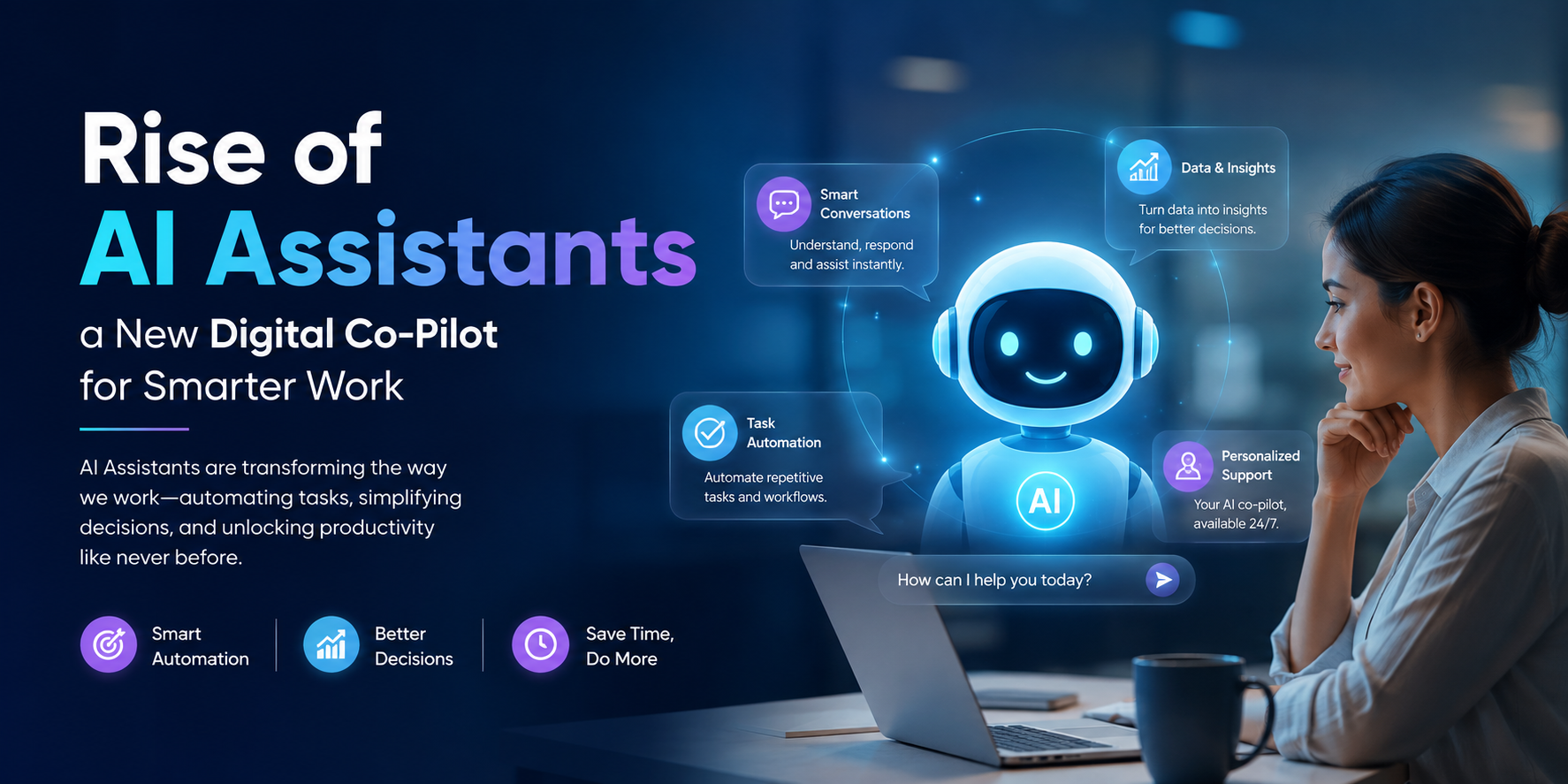
A few years ago, "AI assistant" meant asking your phone to set a timer or play a song. Today, it means something completely different. AI assistants are sitting inside our inboxes, our websites, our documents, and our workflows, quietly doing the heavy lifting so humans can focus on the work that actually needs a human brain.
This shift isn't hype. It's a genuine change in how businesses operate, how customers get answers, and how teams get through their day. Whether you call it a "digital co-pilot," a "smart AI assistant," or an "AI-powered support agent," the underlying idea is the same: software that understands context, learns from your data, and responds like it actually knows what it's talking about.
Let's break down why AI assistants are rising so fast, where they're making the biggest impact, and how you can start using one without hiring a development team.
Why AI Assistants Are Suddenly Everywhere?
Three things came together to make this moment possible.
First, large language models got genuinely good at understanding intent.
Older chatbots could only match keywords to scripted answers. If you phrased your question slightly differently, they'd break. Modern AI assistants, powered by LLMs, actually understand what you mean, even when your wording is messy.
Second, Retrieval-Augmented Generation (RAG) solved the "made-up answer" problem.
Early AI tools were impressive but unreliable, they'd occasionally invent facts. RAG-based AI chatbots fix this by pulling real answers from your actual website, documents, or knowledge base before generating a response. That means the assistant isn't guessing, it's referencing your content directly.
Third, businesses realized customers don't want to wait.
A visitor with a question at 11 PM doesn't care that your support team logs off at 6. If they don't get an answer fast, they leave, and they might not come back. That single expectation, instant answers, at any hour, is arguably the biggest driver behind the rise of AI assistants in business today.
From Personal Helper to Business Co-Pilot
The phrase "digital co-pilot" fits better than "AI chatbot" because of what these tools actually do now:
- They read and understand PDFs, Word documents, spreadsheets, and even CSV or JSON files, then answer questions about them instantly.
- They sit on your website and act as a 24/7 AI customer support agent, handling product questions, and troubleshooting without a human typing a single reply.
- They learn continuously, every conversation and every document you feed them makes the assistant sharper and more accurate.
- They free up your team from repetitive tickets so people can focus on complex, high-value conversations that genuinely need a human touch.
This is the real story behind the rise of AI assistants less about replacing people, more about removing the repetitive, low-value work that burns out support teams and slows businesses down.
Where AI Assistants Are Making the Biggest Difference
Customer Support: This is ground zero for AI assistant adoption. An AI-powered customer support agent trained on your own website and documents can resolve a large share of incoming questions, refund policies, pricing, product specs, without a human ever getting involved. Support teams then only step in for the complex, judgment-call cases.
Document-Heavy Workflows: Sales, legal, HR, and operations teams deal with mountains of PDFs, Word files, and spreadsheets. An AI assistant that can chat with a PDF or an Excel file turns a 20-minute manual search into a 10-second question and answer.
Website Engagement: A website AI assistant doesn't just answer questions; it captures visitors who might otherwise leave. Instead of a static nobody reads, visitors get a real-time conversation that guides them to what they actually need.
Small Business Scaling: Startups and small teams can't always hire a full support staff. A free AI chatbot trained on their own content lets them compete with much larger companies on responsiveness, without the payroll.
What to Look for in an AI Assistant?
Not all AI assistants are built the same. When evaluating one for your business, look for:
- RAG-based accuracy – it should answer from your actual content, not generic internet knowledge.
- No-code setup – you shouldn't need an engineering team to launch it.
- 24/7 availability – the whole point is coverage outside business hours.
- Easy embedding – a simple snippet that fits your website design, not a clunky widget that feels bolted on.
- Analytics – insight into what customers are actually asking, so you can improve your content over time.
This Is Exactly What DBTalker Was Built For
If you're thinking about adding an AI assistant to your website, DBTalker is a straightforward place to start. It's a RAG AI chatbot builder that turns your website, documents into a smart, always-on AI customer support agent, without writing a single line of code.
Here's what makes it a genuine digital co-pilot for your business:
- Trained on your content – feed it your website, Word docs, PDFs, Excel sheets, CSVs, or JSON data, and it learns your business inside out.
- Instant, human-like answers – no scripted replies. It understands context and responds the way a knowledgeable team member would.
- Live in minutes – add your content, train the assistant, and embed it on your site with a one-line snippet. No developers required.
- Always available – it works while your team sleeps, automating a large share of repetitive support questions.
- Built to scale with you – start with a free plan and upgrade as your traffic and support needs grow.
Whether you run an e-commerce store, a SaaS product, or a service-based business, DBTalker helps you turn every website visitor into a satisfied customer instead of a missed opportunity.
👉 Build your free AI chatbot with DBTalker and see how quickly a digital co-pilot can transform the way your business handles support.
The Bottom Line:
AI assistants aren't a passing trend, they're becoming standard business infrastructure, the same way live chat and email support once were. The companies adapting early are the ones giving customers faster answers, freeing up their teams, and quietly gaining a competitive edge.
The technology has matured. The setup barrier is gone. What's left is a simple decision keep making customers wait, or give them a digital co-pilot that's ready the moment they have a question.