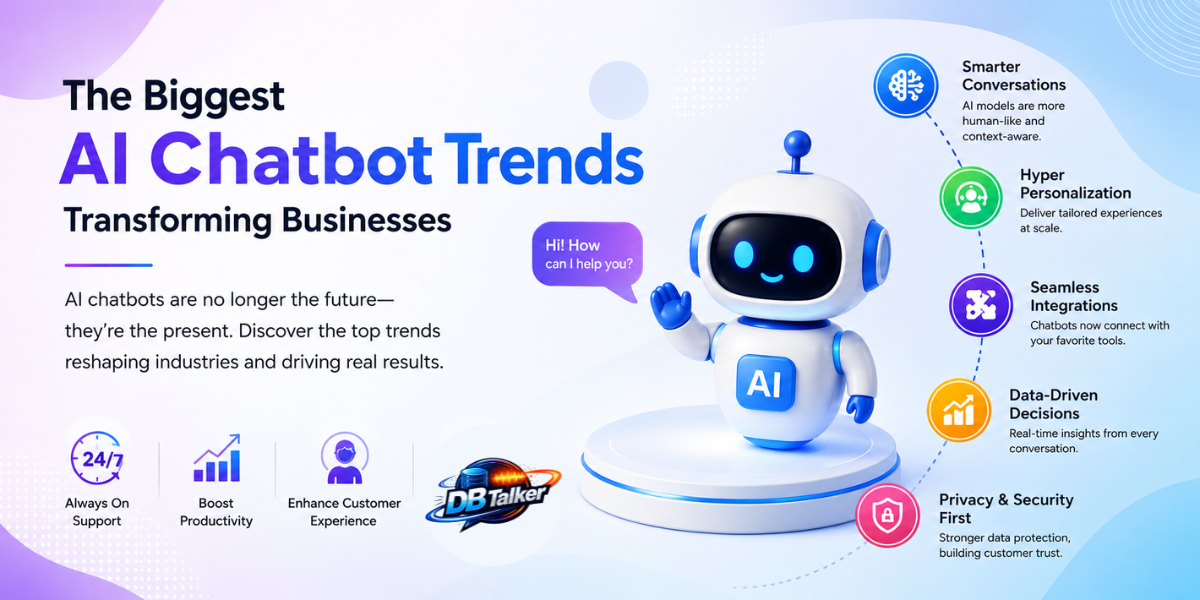
Chatbots used to mean rigid decision trees and canned responses. Today, they're evolving into intelligent systems that understand context, execute tasks, and integrate deeply into how businesses operate.
As customer expectations rise and AI models grow more capable, companies across every industry are rethinking what a "chatbot" can actually do. Here are the trends reshaping the space right now.
- The Rise of AI Agents:
The biggest shift isn't better chat—it's autonomy. AI agents go beyond answering questions; they plan and execute multi-step tasks toward a goal, calling tools and APIs along the way. A retail agent might not just answer "where's my order" but proactively check tracking, issue a refund, and email confirmation—all without human handoff. Businesses are moving from reactive bots to proactive digital workers.
- Multimodal AI Conversations:
Modern chatbots aren't limited to text. Customers can upload a photo of a damaged product, ask a question by voice, or share a screenshot of an error message, and the AI responds appropriately. This multimodal capability makes visual customer support like diagnosing a broken appliance from an image far more effective, while voice-first experiences meet users in hands-free, on-the-go contexts.
- Hyper-Personalized Customer Experiences:
Generic responses are giving way to conversations shaped by real customer data. AI chatbots now pull from purchase history, browsing behavior, and past interactions to offer recommendations that feel tailored rather than templated. Context-aware interactions mean a returning customer doesn't have to repeat themselves the bot already knows their preferences, order status, and prior complaints, creating continuity that feels genuinely personal.
- Generative AI-Powered Customer Support:
Generative AI has transformed support from scripted Q&A into fluid, human-like conversation. Instead of matching keywords to pre-written answers, modern bots generate responses in real time, drawing on intelligent knowledge retrieval to pull accurate, relevant information. The result is faster resolution times and a significant drop in support costs, since AI can handle a large share of tier-1 queries without escalation.
- Omnichannel AI Chatbots:
Customers don't stick to one channel they might start on a website, switch to WhatsApp, and finish via email. Leading businesses now deploy chatbots that maintain a unified identity and memory across websites, mobile apps, Messenger, Slack, and email. Conversation continuity across channels means no repeated explanations and no lost context, which dramatically improves customer satisfaction and reduces friction.
- AI Chatbots with Enterprise Integrations:
A chatbot's usefulness multiplies when it's plugged into core business systems. Integration with CRM platforms lets bots update lead records automatically; ERP and HR system connections enable self-service for employees; and links to helpdesk and ticketing tools mean support requests get logged and routed without manual entry. APIs and workflow automation tie it all together, turning conversations into completed actions.
- AI Copilots for Employees:
Chatbots aren't just customer-facing anymore. Internal AI copilots act as knowledge assistants, helping employees find policies, procedures, or product details instantly. In HR, copilots handle benefits questions and leave requests. IT helpdesk automation resolves password resets and access issues without a ticket. Sales and marketing teams use copilots to draft outreach, summarize calls, and surface account insights boosting productivity across departments.
- Voice AI and Conversational Assistants:
Voice technology has matured significantly, enabling natural, low-latency conversations rather than stilted IVR menus. AI phone agents can now handle appointment scheduling, order status checks, and basic customer service calls with human-like cadence and comprehension. This is especially valuable for industries like healthcare and hospitality, where phone remains a primary channel for many customers.
- Retrieval-Augmented Generation (RAG):
One of AI's biggest challenges has been hallucination confidently wrong answers. RAG AI Chatbot solves this by grounding AI responses in a company's actual documents, knowledge bases, and databases before generating a reply. This real-time document search ensures answers are accurate and current, which is critical for regulated industries where misinformation carries real consequences.
- Responsible AI and Data Privacy:
As AI touches more sensitive workflows, secure deployment has become non-negotiable. Businesses are prioritizing compliance with regulations like GDPR, HIPAA, and SOC 2, especially when chatbots handle health records, financial data, or personal information. Explainability and governance—understanding why an AI gave a particular answer are increasingly required by both regulators and cautious enterprise buyers.
- Low-Code and No-Code Chatbot Development:
Building a chatbot no longer requires a dedicated engineering team. Low-code and no-code platforms with drag-and-drop AI builders let business users marketers, support managers, and deploy conversational flows themselves. This accessibility dramatically shortens development cycles, letting companies launch and iterate on bots in days instead of months.
- Advanced Analytics and Conversation Intelligence:
Every conversation is now a data source. Businesses use sentiment analysis to gauge customer mood in real time, and conversation insights to spot recurring pain points, product issues, or unmet needs. This intelligence feeds directly into performance optimization refining bot scripts, training data, and escalation paths based on what's actually happening in customer interactions.
- AI Automation Beyond Chat:
Chat is increasingly just the interface for something bigger: workflow automation. AI systems now handle multi-step task execution like processing a return, updating inventory, and notifying a warehouse triggered entirely from a conversation. Combined with robotic process automation (RPA), chatbots become the front door to entire automated business processes, not just a Q&A tool.
- Industry-Specific AI Chatbots:
Generic bots are giving way to specialized solutions built for particular industries. In healthcare, chatbots handle symptom triage and appointment booking with HIPAA-grade privacy. Banking and finance bots manage account inquiries and fraud alerts. E-commerce bots drive product discovery and cart recovery. Education platforms use bots for tutoring and enrollment support, while travel, hospitality, and real estate chatbots handle bookings, itinerary changes, and property inquiries with domain-specific accuracy.
The Future of Business Chatbots
Looking ahead, expect multi-agent AI systems where specialized agents collaborate one handling billing, another handling technical support, coordinated seamlessly. Emotion-aware AI will detect frustration or urgency and adjust tone accordingly. Predictive customer engagement will let bots reach out before a problem arises, and increasingly autonomous business operations will let AI manage entire workflows with minimal human oversight.
Conclusion:
The chatbot landscape is moving fast, and staying competitive means preparing deliberately rather than reactively. Evaluate business needs. Start with DBTalker by identifying where conversational AI can genuinely reduce cost, save time, or improve customer experience rather than adopting AI for its own sake.
Choose the right AI platform. Look for solutions that support multimodal input, enterprise integrations, and RAG-based grounding, so the chatbot can scale with your needs instead of becoming another siloed tool.
Build a secure AI strategy. Data privacy and compliance can't be an afterthought. Choose vendors and architectures that support governance, explainability, and regulatory requirements from day one.
Businesses that treat AI chatbots as evolving digital teammates rather than static tools will be best positioned to capture the productivity, cost, and experience gains this next generation of AI has to offer.